Appearance
Quick start: one Capital job
About 20–25 minutes. Keep Q-Team open in another tab.
Use a Capital job that Ben or Bill has set up for practice. Check for the “UAT on real data — nothing is sent” banner. UAT means testing. Do not send these bills to a client or enter them in live QuickBooks.
If the job already has an invoice, follow that record and its History. If a step is blocked, note the reason and ask Ben or Bill for a completed example. Do not guess missing facts.
1. Find and review the job
- Open Timesheets → Review. Under Review by week, find the week ending date and choose Open week.
- Scroll past Open findings to the timesheet table. Find your job by its Work date, Crew and Work order. Choose Show issues at the right of that row. Scroll the table sideways if needed.
- In the area that opens below the row, choose Open this timesheet in its collection. If several captures are listed, use the one Ben or Bill chose. Check that the next page says Showing one timesheet. Note the collection name; it is the batch of imported timesheets you will use in step 2.
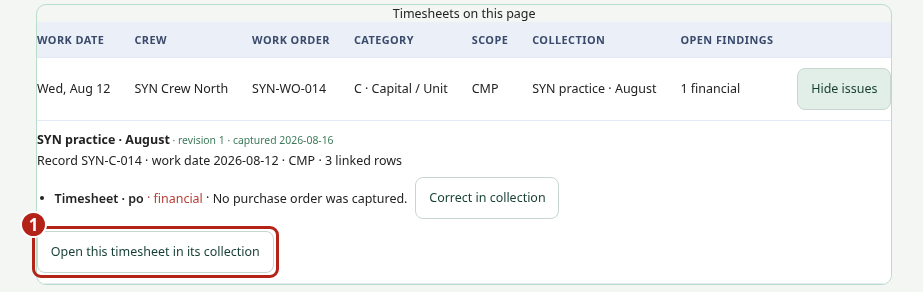
- Under Open findings → To review in CMP scope, read the items for this job. If a group is closed, choose Show timesheets. Note the field it names, such as purchase order (po in the field table).
- Scroll down to Audit detail and open Field-by-field evidence. Find that field in the table. Original value is what was imported; Proposed is the app's suggested value. API interpretation, if shown, is how the app read the imported value. Check Corrected too, if shown; it is a saved change. These are not approved billing values.
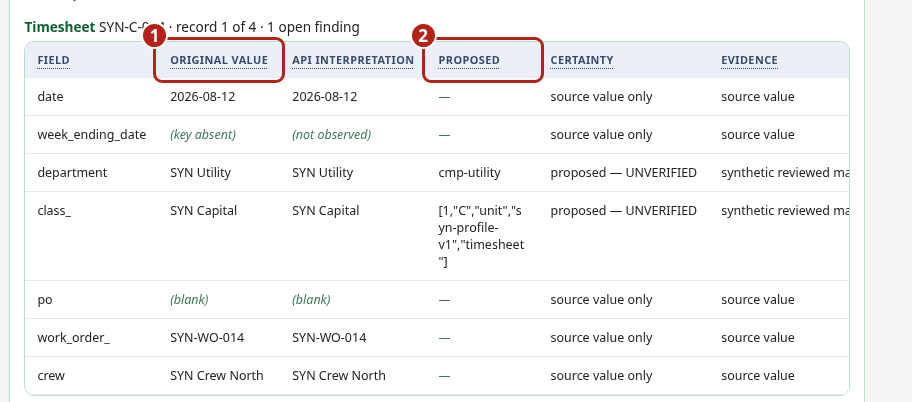
In this example, po is (blank) and Proposed is —: no PO was captured and none is suggested. Do not guess one. If you know the correct value and have proof, scroll back to the finding and choose Correct. Follow the correction steps; otherwise, note the blocker and ask Ben or Bill.
More review help, with screenshots.
2. Prepare a draft
Open Billing → Capital & GTS, then the same collection. Check What the mapping review found and Type of billing CMP authorized.
Choose Prepare source inputs. Select your Source timesheet, then Reserve candidate. A candidate is a proposed invoice. Note its draft invoice number.
3. Check the charges
Check the candidate's Draft total, number of priced lines and source timesheet. Check the work quantity, code and rate for the work date.
Calculate draft is a separate preview of the whole collection. Use it to inspect your job's lines, not to treat the collection total as this invoice's total. Capital details.
4. Review and approve
Go to Invoices → All invoices. Open the draft number and read Next step. Check the amount, job and PO/WO reference.
Enter Reason (why you are taking the action) and Evidence reference (where the proof is). Make clear this is practice. Then follow the offered steps:
- Submit for review.
- Approve.
- Finalize and issue.
Check the result after each click. A hold may still stop the invoice. What these steps mean.
5. Open the documents
Under Invoice package, choose Issue invoice package if no package exists. This creates the files. It does not create another invoice number or send anything.
Open the download. Check its number, date, work description and amount.
6. Check the handoff
Choose Prepare delivery, then Open prepared deliveries. Check who the package is meant for and which version it contains. Use only actions marked as test simulations. Delivery and returns.
Back in All invoices, open the QuickBooks worksheet if shown. Compare it with what you would type by hand. Do not enter this practice bill in live QuickBooks.
7. Give feedback
Note the page, what you expected and what happened. Include any rule that does not match how you bill the work.